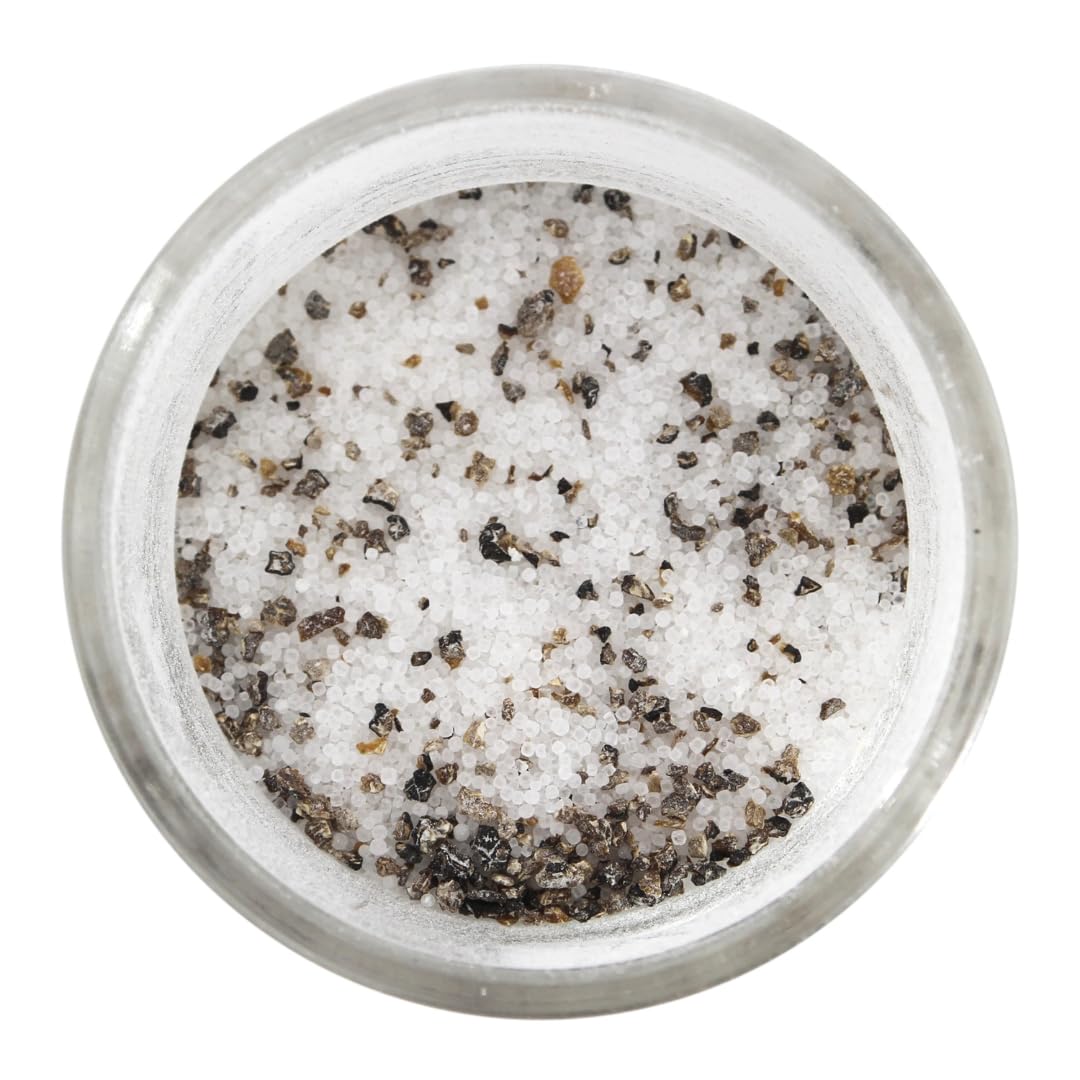
Truffle salt sounds like a luxury shortcut — and done right, it genuinely is. A truffle (think: a knobby, intensely aromatic underground fungus, the kind that commands hundreds of dollars per pound at peak season) paired with good flaky sea salt should, in theory, give you a finishing condiment that punches far above its price point. The problem is that roughly 80% of what’s sold as “truffle salt” doesn’t actually contain meaningful amounts of truffle at all. Instead, the aroma comes from a synthetic compound called 2,4-dithiapentane — a lab-made molecule that approximates one facet of truffle’s smell but misses almost everything that makes a real truffle worth chasing. If you’ve ever sprinkled a “truffle salt” on pasta and thought “this smells weirdly artificial,” that’s why.
This guide will help you read a label fast, understand the two main truffle species you’ll encounter, calibrate your price expectations, and — if you’re building a salt pantry worth recommending to others — identify which products are actually worth the shelf space. We’ll name tradeoffs directly and end with a clear decision rule, because this is genuinely a category where the $14 jar and the $42 jar can be separated in about thirty seconds if you know what to look for.
| EDITOR'S PICKBlack Truffle Sea Salt | Mid-tier[TRUFF Black Truffle Salt](https://www.amazon.com/dp/B0BG9BNZDW?tag=greenflower20-20) | Budget pick[Sabatino Tartufi](https://www.amazon.com/dp/B091F2NXR1?tag=greenflower20-20) | |
|---|---|---|---|
| Weight | 9 oz | — | 4 oz |
| Truffle type | — | Black Summer | Smoked truffle |
| Real truffle | — | ✓ | — |
| Salt type | Sea salt | Sea salt | Smoked sea salt |
| All natural | — | — | ✓ |
| Price | $16.10 | $12.61 | $11.04 |
| See on Amazon → | See on Amazon → | See on Amazon → |
The Label Tells You Almost Everything in 10 Seconds
Before we get to brands, let’s build the skill that will serve you every time you’re standing in a specialty shop or scrolling a product page: ingredient-list literacy.
What a real truffle salt label looks like:
Sea salt, Tuber melanosporum (black truffle) or Tuber magnatum (white truffle), [sometimes: truffle oil, truffle extract]
What a fake truffle salt label looks like:
Sea salt, natural truffle flavor, truffle aroma, flavoring
That phrase “natural truffle flavor” is doing a lot of work to obscure something simple: the flavor is synthetic. Per Saveur’s long-form investigation into truffle products, the industry term “natural flavor” can legally include 2,4-dithiapentane derived from petrochemical processes — it qualifies as “natural” under FDA labeling rules because of how the compound is processed, not because it comes from a truffle. Food & Wine’s overview of black and white truffles makes the same point: the compound captures only the sulfurous, garlicky register of truffle aroma and skips the earthy, musky, and mushroomy complexity that distinguishes a real truffle experience.
The actionable rule: if you don’t see a Latin species name in the ingredient list, assume the truffle content is either absent or negligible. Real truffle presence is something producers brag about; they will always name the species.
A secondary label check: look for the truffle to appear before salt in the ingredient list, or at least early in it. Ingredients are listed by weight in descending order. Most legitimate truffle salts are still predominantly salt by weight (that’s fine — you’re finishing with it), but the truffle should be specifically named and ideally described as “dried” or “shaved” — indicating real fungal material.
Black vs. White Truffle Salt: The Tradeoff That Actually Matters
Once you’re confident you’re looking at a real-truffle product, the next decision is species. This is where the comparison gets interesting.
Black truffle salt (Tuber melanosporum, the Périgord truffle): More widely available. Holds up reasonably well to mild heat, which makes it practical — a pinch on scrambled eggs, on roasted potatoes just before serving, or on pasta as the dish is plated. The aroma is earthy, forest-floor, and chocolate-adjacent. Serious Eats’ guide to buying and using truffles notes that black truffles are the more forgiving species for home use precisely because they don’t lose their character as instantaneously as white truffles do when exposed to warmth.
White truffle salt (Tuber magnatum, the Alba truffle): Rarer, more expensive, and more volatile — meaning the aroma dissipates faster both on the shelf and on the plate. White truffle character is more floral, garlicky, and honeyed. It should never touch heat; it’s a pure finishing salt, applied after the plate leaves the stove. White truffle salts command a significant premium, and they are appropriate if you’re finishing something that will be eaten immediately — a composed salad, a carpaccio, a buttered crostini. They are a poor choice if the dish will sit even five minutes before service.
By the numbers:
| Truffle type | Typical shelf aromatics | Best application window | Price premium over black |
|---|---|---|---|
| Black (T. melanosporum) | 12–18 months (sealed) | Plating through brief warmth | Baseline |
| White (T. magnatum) | 6–10 months (sealed) | Plate exit, immediate service only | 40–90% higher |
Those shelf-life figures are drawn from producer guidance aggregated across Jacobsen Salt Co., Urbani Truffles, and Saltverk product documentation. The core tradeoff: white truffle salt offers a more complex, prestigious flavor profile but punishes you for any delay in service or inattention to storage. Black truffle salt is the workhorse — more forgiving, still genuinely luxurious, and dramatically better than anything synthetic.
Which Jars Are Actually Worth It
Here’s where we move from decision framework to specific recommendations. These represent products where the ingredient list, sourcing documentation, and aggregated buyer feedback across specialty retailers align well. Because truffle salt is a prestige category prone to overpromising, we’re applying a stricter filter than we would to, say, smoked salts: Latin species name in ingredient list, evidence of real fungal material, and a track record of consistent aroma reports from owners.
Urbani Truffle Salt (Black) — Urbani is one of the oldest truffle trading houses in the world, operating since 1852 out of Umbria, Italy. Their black truffle salt lists Tuber aestivum (summer truffle, a more affordable and widely available black species) clearly on the label, often blended with sea salt from Sardinia. Tasting Table’s overview of truffle salt buying highlights Urbani as a reliable reference point precisely because the brand’s core business is whole truffles — they’re not a salt company that added truffle aroma, they’re a truffle company that added salt. Owners across specialty food retail reviews consistently report a pronounced, earthy, genuinely truffle-forward aroma. Street price: approximately $18–$26 for a 100g jar as of early 2026.
Sabatino Tartufi Truffle Salt — Another Italian truffle-house product, Sabatino lists Tuber aestivum and uses an Adriatic sea salt base. This is arguably the most widely distributed genuine truffle salt in the U.S. market, available through Williams Sonoma and a number of specialty grocers. The flavor is slightly more subtle than Urbani — some owners describe it as “refined” rather than “aggressive” — which makes it a better call for delicate applications like finishing butter or soft-boiled eggs. Price point: $14–$22 for a 3.5 oz container.
Jacobsen Salt Co. Black Truffle Salt — Jacobsen uses Oregon coast sea salt as the base (harvested from Netarts Bay) and sources dried black truffle pieces that are visible in the jar. The brand publishes its sourcing transparently, and Cook’s Illustrated’s broader look at finishing salts has noted Jacobsen’s quality consistency across their infused line. The crystal structure here matters: Jacobsen’s base salt is a medium-flake, which gives you a good textural pop alongside the truffle aroma. This is the strongest option if you want truffle salt that also works as a textural finishing salt, not just a flavoring agent. Price: approximately $22–$32.
Tartuflanghe Truffle Salt (Black or White) — For the collector tier or high-end gifting, Tartuflanghe produces both black (T. melanosporum) and white (T. magnatum) options with explicit harvest-region labeling (Langhe hills, Piedmont). The white truffle version in particular carries a price premium — roughly $38–$55 for a small tin — that is justified by the species and the provenance documentation. If you’re sourcing for a tasting menu or a luxury gift set where the label itself is part of the story, this is the one to reach for.
What to skip: Any jar priced under $10 and positioned as “truffle salt” at a general grocery or discount retailer almost certainly relies on synthetic flavoring. The math simply doesn’t work — real truffle even in dried form is expensive enough that a legitimately truffled 3 oz product cannot be produced and sold profitably at $7.99. Tasting Table’s buying guide flags this price floor explicitly. If the price seems too good, read the ingredient list; you’ll almost always find “natural truffle flavor” or “truffle aroma” doing the heavy lifting.
Storage, Freshness, and When to Use It
Real truffle salt is a perishable aromatic product, not a shelf-stable mineral like plain sea salt. A few decisions here will meaningfully affect your experience:
Store it airtight and cool. Truffle’s volatile aromatic compounds — the ones you actually paid for — dissipate on exposure to air and heat. A jar left open on a counter loses noticeable aroma within days. Seal it immediately after use, and store it away from the stove. Many serious cooks keep truffle salt in a small glass jar with a tight-fitting lid in a drawer rather than on an open spice rack.
Use it cold or at the last possible moment. This applies more strictly to white truffle salt, but it’s good practice for black as well. The finishing window is: plate leaves the heat source, you add the salt, plate reaches the table. Every minute of delay is aroma you’re not capturing.
Don’t cook with it. This is the most common mistake. Truffle salt should never go into a sauté pan, a pasta water pot, or an oven. The aromatic compounds volatilize and burn off before they reach the diner. Use a cheaper salt for cooking; use truffle salt only at the finish.
The Decision Rule
If you’re buying truffle salt for the first time and want to understand what the real thing tastes like: Sabatino Tartufi or Urbani, black truffle, $15–$26 range. The ingredient list will check out, the price is honest, and you’ll have a clear reference point for everything else.
If you’re building a gift set or a charcuterie-and-finishing display for a private dining event: Jacobsen Black Truffle Salt for visual appeal and texture, or Tartuflanghe for provenance storytelling. Both photograph well, both carry a credible label, and both represent the kind of product where the story on the tin matches what’s inside it.
If you’re considering a white truffle salt: only buy it if you have an immediate application — a dinner in the next two weeks — and you’re committed to proper storage. The premium is real, and the flavor is genuinely distinct, but it punishes neglect far more than black truffle does.
The version to avoid in every scenario: anything with “natural truffle flavor” in the ingredient list, regardless of the price. It’s not a lesser version of real truffle salt. It’s a different product wearing the same label, and once you know what to look for, the distinction takes about ten seconds to make.