If you’ve been building a salt pantry for a year or two, you already know that “finishing salt” means a flaky, mineral-forward crystal you add after cooking — a pinch on a steak, a scatter across a piece of dark chocolate — rather than the fine-grain salt you dissolve into pasta water. You’ve probably got Maldon in rotation and maybe a jar of Fleur de Sel. Now you’re looking at gift sets in the $40–$80 range and wondering whether Saltverk’s Icelandic offerings are genuinely special or just beautiful packaging doing heavy lifting. This article exists to answer that question clearly. We’ll look at what Saltverk actually is, how the gift sets are constructed, what you’re paying for at each price point, and when the value proposition holds — and when it doesn’t.
What Makes Saltverk Different From Other Flaky Sea Salts
Saltverk is a small Icelandic producer operating out of the Reykjanes Peninsula in Iceland’s northwest fjords. To understand why that location matters, you need one piece of geology: the salt works sit beside geothermal hot springs, and the producer uses that geothermal energy — essentially free, carbon-neutral heat rising from volcanic activity — to evaporate filtered seawater from the North Atlantic into salt crystals. No coal. No gas. The Saltverk producer site’s harvest methodology documentation describes the operation as one of the few salt producers in the world that is fully geothermal-powered, a distinction that Saveur’s feature “The World’s Most Interesting Salts” called out specifically as setting Saltverk apart from producers who use fossil fuels for evaporation.
That matters for two reasons. First, it’s a genuine provenance story you can repeat at a dinner table and it holds up to scrutiny — it’s not marketing language dressed up as sustainability. Second, geothermal evaporation produces a slower, more controlled crystallization environment than industrial pan-drying, which is part of why Saltverk’s flakes tend to be thinner and more irregular than, say, mass-produced pyramid flakes. The result is a crystal that dissolves quickly on the tongue and delivers a clean, oceanic salinity without the harsh edge you sometimes get from salts processed at high industrial heat.
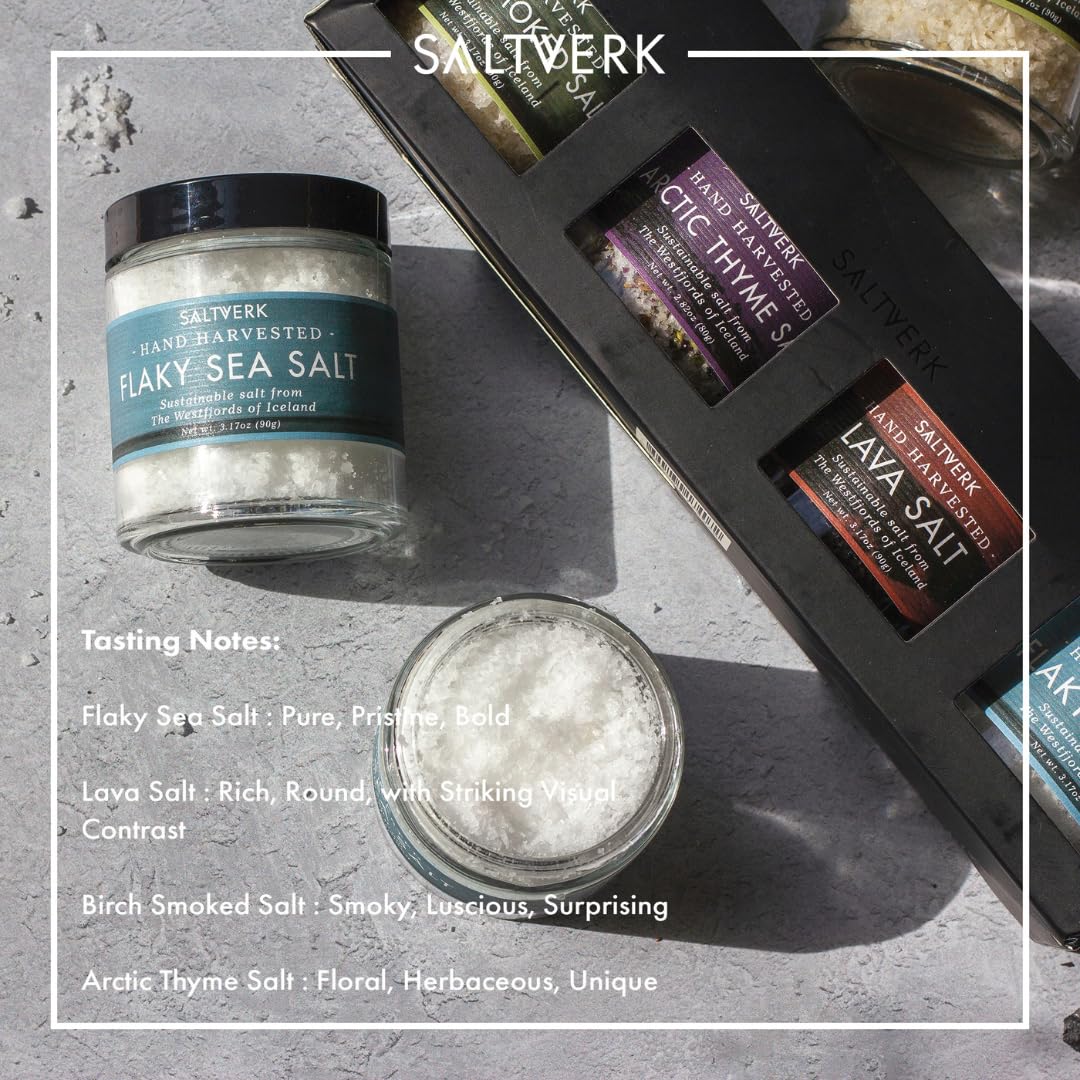
The core product line includes plain flaky sea salt, Birch Smoked Flaky Salt (wood-smoked over Icelandic birch), Arctic Thyme Salt, and Lava Salt — a black finishing salt colored by activated charcoal. The gift sets bundle two to five of these into coordinated packaging.
How the Gift Sets Are Constructed — and What You’re Actually Paying For
Saltverk’s retail gift sets currently fall into roughly three tiers:
By the numbers (May 2026 pricing, sourced from The Meadow listings and Saltverk producer site):
| Set | Contents | Approximate Retail |
|---|---|---|
| Duo Gift Box | 2 salts (e.g., Flaky + Birch Smoked) | $38–$45 |
| Discovery Set | 4 salts (Flaky, Birch Smoked, Arctic Thyme, Lava) | $58–$72 |
| Full Collection / Premium Box | 5+ salts, includes seasonal or limited variants | $80–$105 |
Per-unit cost math is worth running here, because this is where intermediate buyers sometimes pause. The plain Saltverk Flaky Sea Salt retails individually for roughly $14–$18 for a standard 90g tin. The Birch Smoked Flaky Salt sits at $28–$38 on its own depending on the retailer. If you’re buying the Discovery Set at $68, you’re paying approximately $17 per component — which pencils out favorably on the smoked and infused variants and roughly at par on the plain flaky salt. You’re not paying a massive gift-set premium; the packaging is absorbing maybe $6–$10 of the total, which is reasonable for what you get.
What the packaging actually delivers matters here. Saltverk uses matte-finish tins with clean Scandinavian typography and a color-coded system by variant. Food & Wine’s 2025 finishing salts buying guide noted the Saltverk tins as among the most shelf-presentable options currently available, specifically because the design is restrained rather than ornate — it doesn’t look like a holiday novelty item, so the recipient can display it without embarrassment twelve months later. If you’re buying this as a gift for a home cook who cares about their kitchen aesthetic (and at this price point, they usually do), that’s not a trivial consideration.
Flavor and Texture: Matching Each Salt to Its Best Use
Even at the intermediate level, it’s worth being precise about where each Saltverk variant earns its place on the plate, because the gift sets work best when the recipient understands what they’re working with.
Plain Flaky Salt — Thin, irregular flakes with a clean oceanic flavor and low bitterness. Serious Eats’ explainer on finishing salts notes that low-bitterness salts with rapid dissolution are best suited to raw applications: salads, crudo, fresh tomatoes, butter. Reviewers across The Meadow’s tasting notes and aggregated buyer reviews consistently describe the plain Saltverk flake as “bright” and “mineral without being aggressive,” which tracks with its North Atlantic source water. Our editorial read: this is the everyday finisher of the line — the one that will get used fastest.
Birch Smoked Flaky Salt — This is the set’s anchor piece and the strongest argument for Saltverk over competitors. The smoking is done over Icelandic birch, which produces a lighter, more aromatic smoke profile than the heavier hickory or alderwood notes you get from Pacific Northwest smoked salts. Owners who post long-term use notes on specialty food forums describe the birch smoke as more “perfumed” than “barbecue,” which makes it work on eggs, on grilled fish, and — perhaps most usefully — on desserts like dark chocolate or butterscotch without the savory smoke clashing. If someone in your life is serious about charcuterie or cured fish, this variant alone may justify the set.
Arctic Thyme Salt — Dried Icelandic thyme blended with the flaky base. The herb is harvested wild from the Icelandic highlands, per Saltverk’s producer documentation. This is the most specific-use salt in the line: excellent on lamb (Icelandic sheep, in a satisfying provenance symmetry), roasted root vegetables, and compound butters. Less versatile than the plain or smoked variants, but precisely good at what it does.
Lava Salt — Activated charcoal gives this an inky black color that is genuinely dramatic on a white plate. The flavor contribution from the charcoal is minimal — this is primarily an aesthetic salt. Food & Wine’s guide explicitly positions it as a “presentation” salt rather than a flavor-forward finisher. Worth knowing before you hand a set to someone who will feel deceived if the black salt tastes like plain salt. It does, mostly. That’s fine; use it accordingly.
The Honest Tradeoff Analysis: When Saltverk Earns the Price and When It Doesn’t
This is where we put the decision framework to work, because “Saltverk is good” is not a useful answer when you’re deciding between this and two or three other options at the same price point.
Saltverk wins against competitors when:
The recipient or buyer cares about provenance as part of the gift story. The geothermal harvest narrative is real, verifiable, and distinctive in a way that, say, a Welsh or French fleur de sel cannot easily replicate — those are excellent salts, but “harvested by hand in tidal pools” is a more generic story than “evaporated using volcanic hot springs.” If you’re giving this to a professional chef sourcing for a tasting menu where provenance language appears on the menu card, Saltverk gives you something specific to print. Saveur’s feature article flagged this exact use case.
The buyer wants long shelf life and durable packaging. Saltverk tins are sealed, opaque, and moisture-resistant. For a specialty food retailer stocking a gifting display, these hold presentation quality longer than kraft-paper-wrapped salts or open-lid jars that absorb humidity.
The flavor profile leans toward lighter, brighter cuisine — Scandinavian, Japanese-influenced, raw preparations, fish. If your household or client’s cuisine runs toward heavy braises, heavily spiced rubs, or aggressive chiles, the delicacy of the birch smoke and the brightness of the plain flake may get lost. In that context, a heavier smoked salt (think Salish or a Pacific alderwood) might deliver more perceptible impact.
Saltverk faces real competition when:
You are in the $60–$80 range and comparing the Discovery Set against a Jacobsen Salt Co. infused salt bundle or a SaltWorks Marx Foods curated tin set. At that price point, Jacobsen offers more flavor variety in their infused line (truffle, lemon zest, ghost chili, etc.), which may better suit a recipient who wants to experiment widely. The Saltverk line is narrower — four or five core variants — and the philosophy is restraint rather than variety. That’s a preference question, not a quality question. Neither is wrong; they serve different gift personalities.
You are buying for a collector or serious enthusiast in the $80–$120 tier. At that budget, the conversation shifts toward single-origin limited harvests — Hana Flake Hawaiian sea salt, Halen Môn’s Gold edition, or seasonal Saltverk limited releases when available. The standard Saltverk Discovery Set is excellent but it is not a collector’s item. Don’t position it as one.
Decision Rules: If X, Then Y
Here’s the framework, stated plainly:
If you’re buying a $50–$75 food gift for someone who appreciates clean design, has an interest in sustainability or origin stories, and cooks fish, eggs, or charcuterie — then the Saltverk Discovery Set is the most defensible choice at that price point. The math is fair, the packaging earns the shelf, and the birch smoked salt specifically is difficult to replicate at the same price elsewhere.
If the recipient is a variety-seeker who wants to experiment with a wide flavor range — then pivot to a Jacobsen or SaltWorks curated bundle. More surface area for exploration; less coherent provenance story, but that may not matter to them.
If you are a professional chef or caterer and want to put Saltverk’s name on a tasting menu — then order the plain flaky and birch smoked direct from the producer in larger format jars (available on the Saltverk producer site) rather than the gift set tins, which are portioned for home use. The per-gram economics improve significantly at volume.
If your budget is $80+ and the recipient is a serious salt collector — then check Saltverk’s site for limited seasonal releases before defaulting to the standard collection set. Limited-run variants appear periodically and carry a meaningfully different value proposition for the enthusiast tier.
The bottom line: Saltverk’s gift sets are not premium packaging dressed around commodity salt. The harvest methodology is real, the flavor profile is specific and well-executed, and the price-per-component math is honest. For the right recipient and the right occasion, they are genuinely among the stronger finishing-salt gift options currently on the market in the $40–$80 range.