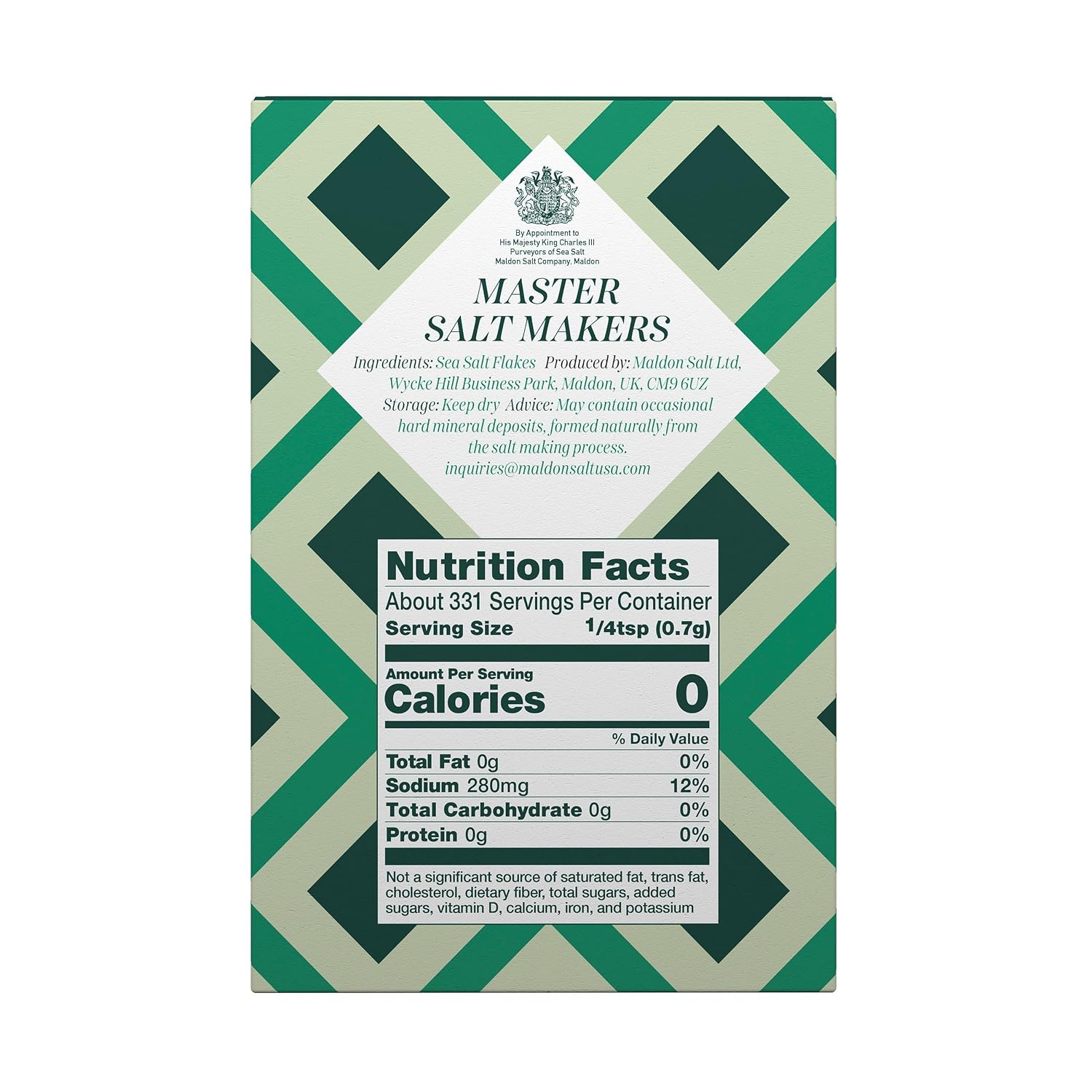
If you’ve ever stood at a grocery store shelf, spotted that distinctive green-and-white box of Maldon, and thought I hear everyone talking about this — but is it actually worth it? — this article is your answer. Maldon Sea Salt Flakes are a finishing salt, meaning they’re not used to season a pot of boiling pasta water (that’s what your cheap table salt is for). They’re added after cooking, right at the moment of serving, to deliver a pop of clean, bright saltiness and a satisfying crunch. The magic is in the crystals: Maldon’s signature hollow pyramid flakes (thin, geometric crystals that collapse pleasantly on the tongue) dissolve faster and taste lighter than dense granulated salt. That means you get more perceived flavor with less actual sodium — which is why chefs and serious home cooks reach for it. What you probably don’t know yet is that Maldon now sells in at least six distinct formats, and buying the wrong one for your use case is an easy, quietly expensive mistake to make.
Why Maldon Still Earns Its Place in a Crowded Finishing-Salt Market
Let’s be honest: the premium salt category has expanded dramatically. You can now reach for Fleur de Sel de Guérande, Halen Môn Pure Sea Salt, Jacobsen Oregon Flake, or a dozen single-origin harvests that didn’t exist on retail shelves five years ago. So why does Maldon — harvested from the Blackwater Estuary in Essex, England, and produced by the same family operation since 1882 — still show up on nearly every short list?
The answer is consistency and value density. As Samin Nosrat notes in Salt Fat Acid Heat (Ten Speed Press, 2017), Maldon is the finishing salt she defaults to for everyday cooking precisely because it’s reliably available, reliably clean in flavor, and priced accessibly enough to use with a genuinely free hand. You’re not rationing it the way you would a $65 tin of Hana Flake Hawaiian sea salt. That freedom matters: a finishing salt you use too sparingly because it’s precious doesn’t do its job.
The Serious Eats staff editorial on finishing salts makes a related point — Maldon’s hollow-pyramid crystal structure means it adheres to food surfaces better than spherical or granular crystals, which tends to roll off. That’s not marketing language; it’s why a pinch of Maldon on a chocolate chip cookie hits differently than the same weight of fine sea salt.
Where Maldon sits in your pantry hierarchy:
- Everyday finishing (steaks, eggs, salads, avocado toast): Maldon’s primary home
- Gifting and presentation: the smoked variant and the larger tins compete here
- Delicate raw applications (crudo, oysters, fresh butter): Fleur de Sel de Guérande still has the edge for texture refinement
- High-heat cooking or brining: neither Maldon nor any flake salt belongs here
The Format Comparison: What’s Actually Different
This is where most buying guides stop too early. Maldon sells in at least six formats as of mid-2026, and the differences between them are not trivial.
The Classic Box (240g / 8.5 oz)
The green cardboard cube is the entry point and, for most home cooks, the right buy. At roughly $8–$10 across Amazon, Williams Sonoma, and direct, it delivers the full pyramid-flake experience in a shelf-stable, humidity-resistant package. The cardboard breathes just enough to prevent the clumping that ruins fine salts stored in open crocks. Reviewers across aggregated retail platforms consistently note this format lasts an average household six to eight months with regular use — which is the right frequency to be buying finishing salt.
If X, then Y: If you’re a home cook finishing two to four meals per week, the 240g box is your default. Buy two at a time; the second one stores fine for 18+ months.
The Large Box (1.5 kg / 53 oz)
Maldon sells a bulk box that shows up in restaurant supply and specialty food retail, and increasingly on Amazon. Priced around $28–$35, the cost-per-ounce math favors it meaningfully over the 240g box — roughly 55–65 cents per ounce versus 95 cents to $1.10. But there’s a real tradeoff: the larger format is less humidity-resistant because you’re opening and closing it far more frequently over its longer lifespan. In kitchens without a proper salt cellar or airtight transfer container, owners report clumping by month three or four. The Cook’s Illustrated tasting notes on finishing salts specifically flag moisture management as the primary degradation factor for flake salts stored in bulk.
If X, then Y: If you’re a private chef, caterer, or home cook finishing eight or more meals per week, the 1.5 kg box pencils out. Transfer it into a wide-mouth glass jar with a silicone-sealed lid on day one and you eliminate the clumping risk entirely.
The Tin (250g)
This is Maldon’s premium retail presentation — same salt, metal tin, roughly $12–$16. Is the tin worth the price premium over the box? Editorially, the answer is: only for gifting. The tin photographs beautifully, survives shipping without crushed corners, and reads as a considered present. For your own pantry, you’re paying a 40–60% premium for packaging you’ll recycle in six months. The New York Times Cooking piece by Tejal Rao on salt selection makes exactly this point — tin presentation elevates the gift narrative without changing the salt itself.
If X, then Y: Buy the tin when it’s going on a charcuterie board setup at a dinner party, into a gift basket, or to a host. Buy the box for your own cooking.
Maldon Smoked Sea Salt Flakes (125g)
This is the format where Maldon most directly competes with specialty salts like Saltverk Birch Smoked Flaky Salt. The smoked Maldon is cold-smoked over oak and comes in at roughly $10–$14 for 125g — smaller than the classic box because you use it with more restraint. The flavor profile reads as subtler and less resinous than Saltverk’s birch smoke, which some cooks prefer (it doesn’t overpower delicate proteins) and others find underwhelming if they’ve calibrated their palate to more assertive smoked salts.
The practical tradeoff is this: Maldon Smoked is more widely available (most Williams Sonoma locations carry it; Saltverk often requires a direct order) and about 30–40% less expensive per ounce than Saltverk at current 2026 pricing. It’s the easier everyday answer for finishing grilled meats, roasted sweet potatoes, and dark chocolate desserts. Saltverk earns its premium if smoke is a primary flavor note in your dish, not a supporting one.
By the numbers:
| Format | Size | Approx. Price (2026) | Cost/oz | Best Use Case |
|---|---|---|---|---|
| Classic Box | 240g / 8.5 oz | $8–$10 | ~$0.95–$1.10 | Everyday finishing |
| Large Box | 1.5 kg / 53 oz | $28–$35 | ~$0.53–$0.66 | High-volume / catering |
| Tin | 250g / 8.8 oz | $12–$16 | ~$1.36–$1.82 | Gifting, presentation |
| Smoked Flakes | 125g / 4.4 oz | $10–$14 | ~$2.27–$3.18 | Smoked-finish applications |
Maldon with Chili Flakes and Other Infused Variants
Maldon has expanded into a small range of infused flakes — chili, garlic, and a sea salt and black pepper version have appeared in specialty retail and online. These compete more directly with Jacobsen infused salts ($22–$38) than with the classic Maldon. The honest assessment, drawing from Epicurious’s guide to salt types and the broader pattern in aggregated retail reviews: the infused variants are convenient, but the infusion quality is modest compared to dedicated artisan infusions. You’re essentially buying Maldon’s delivery mechanism (the pyramid flake) with a fairly straightforward flavoring layer on top. That’s not a bad thing — especially if you want one salt to do double duty on a dinner-party charcuterie spread — but it shouldn’t replace a thoughtfully constructed infused salt if you’re serious about that flavor vector.
If X, then Y: If you want a flavored finishing salt that photographs well and requires no explanation to guests, the chili or garlic Maldon works. If you’re building a curated salt pantry and want the best smoked or infused expression in each category, source those from specialists and keep Maldon in its lane.
How to Use Maldon the Right Way (and the Mistakes That Waste It)
The most common mistake home cooks make with Maldon — confirmed by the pattern across serious food media including Serious Eats and Bon Appétit editorial coverage — is using it too early. Flake salts are not designed to survive heat. The hollow pyramid structure collapses and the crystal dissolves long before it can deliver its textural payoff. Add it at the absolute last moment: on steak after it rests, on eggs just before they leave the pan, on a salad once it’s plated.
The second mistake is using too little. Because the flakes are voluminous and light, a pinch looks like a lot but weighs very little. Samin Nosrat’s practical guidance in Salt Fat Acid Heat is instructive here — she describes finishing with Maldon as a genuinely free-handed gesture, not a precise measurement. If your finished dish tastes flat despite adding Maldon, you likely added less than you thought.
A third consideration for the serious practitioner: pinching versus grinding. Maldon sells a grinder format (the crystals are sized to grind, though purists argue grinding defeats the structural purpose of a flake salt). Epicurious’s guide to salt types notes this debate directly — grinding a flake salt produces an inconsistent particle size and partially negates the textural advantage. Our editorial read: buy the box, use your fingers, embrace the slight mess. That’s the experience the salt was designed for.
The Clear Decision Framework
After surveying the full Maldon lineup against current 2026 market pricing and positioning, here’s the honest summary:
- You cook regularly and want an everyday finishing salt: Classic 240g box, repurchased every six to eight months. Full stop.
- You cook at volume — catering, private dining, meal prep for a large household: 1.5 kg bulk box, transferred to a sealed glass jar. The math is meaningfully better.
- You’re buying a food gift or hosting a dinner party where the salt will be visible: The tin earns its premium. It’s a legitimate presentation object.
- You want a smoked finishing salt: Maldon Smoked is the accessible, widely-available choice. Saltverk Birch Smoked is the step-up if smoke is carrying your dish.
- You’re comparing Maldon to Fleur de Sel or Halen Môn: These aren’t direct competitors. Maldon is your high-frequency finishing salt; Fleur de Sel is your delicate, occasion-specific salt for raw applications and refined presentations. You want both, and they don’t overlap much in practice.
Maldon isn’t the most exciting salt in a serious pantry. It’s the most reliable one. That’s a different kind of value — and for a finishing salt you’ll reach for every day, reliability is exactly what you need.