Gourmet Salt Gift Sets That Don’t Look Like an Afterthought: A Curated Guide
If you’ve ever handed someone a gift set and watched them say “oh, nice” in that polite, unconvinced way, you know the feeling you’re trying to avoid. Salt gift sets are everywhere now — stacked near checkout counters at Williams Sonoma, bundled on artisan food sites, and listed across Amazon in the hundreds. Some of them are genuinely spectacular: thoughtfully curated collections of finishing salts (meaning salts you add after cooking, directly on food, to add flavor and texture) from single-origin harvests around the world. Others are four plastic tubes of aggressively flavored salt in a box that looks good for thirty seconds and tastes like nothing special. The difference matters — and once you know what to look for, it’s not hard to spot.
This guide is for people who are already somewhere past the beginning. You know Maldon from Morton. You’ve probably bought a finishing salt or two for yourself. Now you’re choosing a set — either as a gift for someone else or to deliberately fill gaps in your own salt pantry — and you want to make the right call without overthinking it. We’ll lay out the tradeoffs, show the math on value, and end with clear decision rules so you can move.
Why Most Salt Gift Sets Disappoint (And What the Good Ones Do Differently)
The core problem with most sets isn’t quality — it’s curation. A lot of producers treat the gift set as a clearinghouse for their full product lineup: six salts, two of which are redundant, one of which is genuinely interesting, and the rest filler. The packaging does the heavy lifting, and the contents are an afterthought.
What distinguishes a well-constructed set is editorial restraint. The best ones answer a specific question: What would a cook actually reach for across different situations? That usually means a deliberate range of textures (flaky, coarse, fine), at least one smoked or infused variety for contrast, and ideally a short story — a harvest location, a production method, a flavor note — for each salt included.
Serious Eats, in their overview of finishing salts, makes an important point that gift-set buyers often miss: crystal structure is not decorative. A large pyramid flake like Maldon sits on food differently than a fine grain, dissolves at a different rate, and delivers salt in a different way on the palate. A well-curated set shows that range. A poorly curated one gives you six variations on “coarse sea salt” with different colored labels.
The other thing that matters: context materials. A set that includes a tasting card, a brief regional note, or a suggested pairing — even just printed inside the lid — converts an anonymous box of salt into an experience. Saveur has noted in their coverage of artisan sea salts that provenance storytelling is a significant part of what justifies the price premium in specialty food categories. Gift sets that include that context feel worth the money. Sets that omit it feel like repackaged bulk product.
The Four Price Tiers, and What You Actually Get
Here’s the honest math on what different price points deliver:
| Price Range | What You’re Buying | Best For |
|---|---|---|
| $25–$45 | 3–5 salts, mostly regional variety, basic packaging | First-time gift, casual occasions |
| $45–$80 | 4–6 salts, strong provenance story, quality tin or box | Serious home cook, food-curious friend |
| $80–$120 | Limited-harvest or single-origin salts, collector-tier presentation | Enthusiast, chef, milestone gift |
| $120+ | Rare or seasonal harvests, often signed/numbered | Collector, gift for someone who has everything |
A few things to notice here. The $45–$80 range is where the value curve bends most favorably. Sets like the SaltWorks Artisan Sea Salt Collection and Marx Foods curated samplers in this range consistently deliver more editorial intentionality — tasting notes, regional diversity, and at least one genuinely hard-to-find salt — than anything at the $25–$45 level. The Meadow’s curated tasting sets, available through their Portland and New York retail locations and direct site, land in this tier and are consistently recommended by culinary instructors for salt education because each variety is chosen to illustrate a distinct point about mineral content or texture.
At $80–$120, you’re in collector territory. Hana Flake Hawaiian sea salt, harvested in small batches on Maui, commands prices in this range for good reason: the mineral profile from the volcanic substrate is genuinely distinct, the harvest is weather-dependent and limited, and the flake structure is visually striking. Food & Wine has highlighted Hana Flake among the most distinctive domestic finishing salts available in the U.S. market. For someone who already owns five salts, this is what moves the needle.
The Sets Worth Talking About Specifically
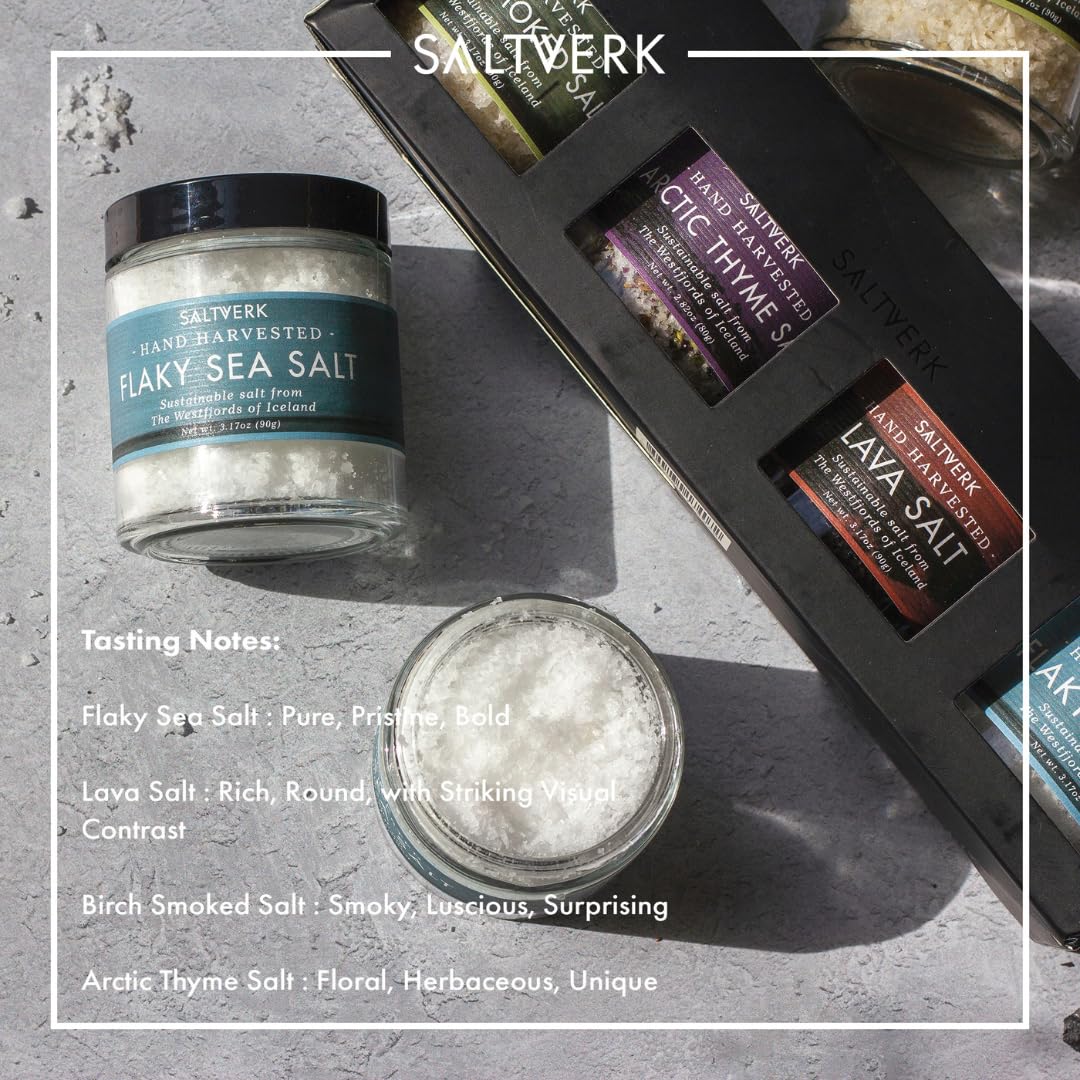
For the enthusiast who already has Maldon: Look at sets anchored by Saltverk’s Icelandic offerings. Saltverk produces its flaky sea salt using geothermal energy from Iceland’s hot springs — a legitimately unusual process that results in a clean, mineral-forward flake with very low bitterness. Their Birch Smoked Flaky Salt ($28–$45 for a single tin, more as part of a set) is the one that repeatedly appears on editorial shortlists. Saltverk’s own producer notes describe the beechwood and birch smoking process in detail, and reviewers across specialty food retailers consistently cite the smoke as integrated rather than overpowering — the distinction that separates a useful smoked salt from a novelty item.
For the gift buyer who wants shelf elegance: Jacobsen Salt Co. gift sets in the $40–$65 range are a reliable pick. The packaging is genuinely beautiful — clean, minimal, photogenic — and the salts themselves carry a real provenance story: harvested from Netarts Bay on the Oregon Coast. Jacobsen’s infused salts (black garlic, lemon zest, habanero) are well-regarded for using real ingredients rather than flavoring extracts, which you can taste immediately in comparison. These sets photograph well, ship cleanly, and land with the shelf presence that makes the recipient feel like they received something considered.
For the professional or semi-professional buyer purchasing in quantity: The calculus shifts. At the $60–$80 per-set level, buying three to five identical sets for client gifts or event favors makes sense only if the sets carry a story the recipient will actually notice. SaltWorks’ limited-harvest tins and Marx Foods sampler collections are worth evaluating here — both offer quantity pricing tiers and product consistency that smaller artisan producers sometimes can’t match for bulk orders. The Meadow also offers wholesale inquiry options for culinary programs and events.
For the serious collector or the person who has literally everything: A single tin of Hana Flake Hawaiian sea salt or a limited seasonal run from Halen Môn (a Welsh producer operating out of the Menai Strait, frequently cited in Saveur and Food & Wine for their protected designation of origin status) is a stronger choice than another multi-salt sampler. One remarkable salt, properly presented, reads as more intentional than a box of five mediocre ones.
The Tradeoffs You Need to Name Before Buying
Novelty vs. usability. Flavored and infused salts photograph beautifully and create a strong first impression. But if the recipient is a serious cook, they often sit on the shelf. Plain finishing salts — good flaky sea salt, a quality fleur de sel (the delicate, hand-raked crust that forms on the surface of salt pans, harvested only under specific weather conditions) — get used. Think about whether you’re optimizing for the opening moment or the long tail of use.
Presentation vs. content. A beautiful tin with mediocre salt is still mediocre salt. Conversely, a kraft paper bag with exceptional single-origin product can feel underdressed as a gift. The best sets balance both. If you’re choosing between them, content wins for anyone who will actually cook with it; presentation wins for a display-oriented recipient or a corporate gifting context.
Quantity vs. quality. A six-salt sampler at $50 averages $8.33 per salt. A three-salt set at $50 averages $16.67 per salt. The math usually favors fewer, better salts — especially if those salts are genuinely hard to source individually.
If X, Then Y: Decision Rules
The clearest way to end this is with explicit if/then framing, because the right set depends almost entirely on who you’re buying for and what situation you’re in.
If the recipient is a home cook who’s curious but new to specialty salts: Choose a $35–$55 set with strong regional range, tasting notes included, and at least one smoked or flavored variety to make the experience feel exploratory. Jacobsen’s entry-level gift sets or SaltWorks’ artisan sampler hit this mark.
If the recipient already curates their salt pantry: Skip the samplers. Go for one exceptional, hard-to-source salt — Hana Flake, a Halen Môn seasonal run, or a Saltverk limited release — properly packaged. One surprising salt beats five familiar ones every time.
If you’re buying in quantity for professional gifting or events: Prioritize sets with consistent packaging, quantity pricing, and a story that communicates quickly — because the recipient will spend thirty seconds with it before setting it aside. Jacobsen and SaltWorks both support this use case well.
If your budget is under $40 and you want the set to feel considered: Spend it on two or three single tins from producers with strong visual branding and clear provenance, arranged in a nice box, rather than a pre-packaged set at the same price point. The Meadow’s individual tins are worth considering here.
If you’re choosing for someone who will actually use and notice the salt: Always bias toward crystal texture diversity (at least one flake, one coarse, one fine in a set) and minimal flavoring. Serious cooks reach for plain finishing salt constantly; they reach for flavored salt occasionally.
The market for specialty salt gifts has genuinely matured over the last few years. The category is no longer dominated by novelty; there are now enough credible producers with real stories and real products that buying well is straightforward if you know the decision frame. You do now.