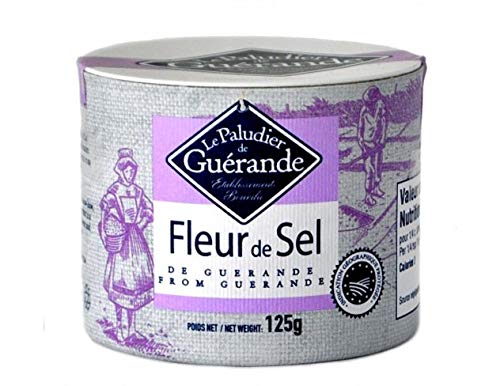
If you have ever sprinkled a pinch of something labeled fleur de sel over a perfectly cooked piece of fish and thought “wait, is this actually different from the stuff in my shaker?” — you are already asking the right question. Fleur de sel (pronounced flur duh sel, French for “flower of salt”) is a finishing salt — meaning it is added at the very end of cooking or right at the table, not during the cooking process itself. Unlike table salt, which is mined from underground deposits and heavily processed, fleur de sel is hand-skimmed from the surface of salt ponds called marais salants during warm, windy afternoons. That skimming window is genuinely brief: the delicate crystals form only when conditions are exactly right, which is why the harvest is small, why the price is higher, and why the texture is unlike anything you pour from a Morton canister. This guide is going to do two things: explain what actually separates a $14 tin from a $38 one, and run the cost-per-pinch math so you can make a clear-eyed decision about which harvest belongs in your pantry right now.
What You Are Actually Paying For (And What You Are Not)
Let’s start with the tradeoffs that most buying guides skip over.
Origin is real, but it’s not a guarantee of quality. The most famous source is Guérande, on the Atlantic coast of Brittany, France. Fleur de Sel de Guérande carries an IGP designation — Indication Géographique Protégée — which functions roughly like a regional certification for wine: it means the salt was harvested within a specific geographic boundary, using specific methods. Per Smithsonian Magazine’s coverage of salt harvesting traditions, this IGP status took decades of advocacy from paludiers (salt farmers) to secure, and it does provide a genuine baseline of traceability. But IGP is a floor, not a ceiling. Two Guérande producers can deliver meaningfully different crystals depending on their specific pond conditions, the weather in a given summer, and how quickly the salt is packed after harvest.
Other respected origins — the Île de Ré (also Brittany), the Camargue in southern France, and newer non-French producers like Saltverk in Iceland — carry no IGP protection but can produce exceptional product. Fine Cooking’s overview of salt variety notes that what most affects fleur de sel’s flavor is not the geographic label but the mineral composition of the brine and the moisture content at the moment of harvest. A wetter fleur de sel (higher moisture content, typically 3–8%) has a softer, more delicate crunch and a slightly briny, mineral finish. A drier one lasts longer in an open ramekin on a dining table but loses some of that fresh-ocean character.
Texture is the actual differentiator at the table. When Serious Eats examined finishing salts for their product guide, the key evaluation axis was crystal structure — specifically how a salt dissolves against the palate and whether it provides punctuation (a bright, distinct hit of salinity) or simply melts into the food. Fleur de sel’s irregular, slightly moist flake clusters do something table salt cannot: they sit on the surface of food briefly before dissolving, creating a moment of crunch followed by a bloom of flavor. That sequence is the whole argument for the price premium. You are not paying for more sodium chloride. You are paying for controlled dissolution timing.
What you are NOT paying for: a meaningful nutritional difference. Both food industry research and consumer food science writers at outlets like Saveur are consistent on this point — trace minerals in artisan sea salt exist but are present in quantities too small to have any measurable dietary significance. The case for fleur de sel is entirely sensory and culinary, not health-based. Anyone marketing it otherwise is selling you a story the chemistry does not support.
The Cost-Per-Pinch Math (Run It Before You Buy)
Here is where most “buying guides” go soft. Let’s be direct.
By the numbers:
| Product | Typical Retail (May 2026) | Net Weight | Pinches Per Tin* | Cost Per Pinch |
|---|---|---|---|---|
| Fleur de Sel de Guérande (Le Paludier, 4.4 oz) | $14–$18 | ~125g | ~500 | $0.03–$0.04 |
| Fleur de Sel de Guérande (Le Saunier de Camargue, 4.4 oz) | $16–$22 | ~125g | ~500 | $0.03–$0.04 |
| Halen Môn Anglesey Sea Salt Flakes (3.5 oz) | $24–$30 | ~100g | ~400 | $0.06–$0.08 |
| Saltverk Fleur de Sel (3.5 oz) | $22–$28 | ~100g | ~400 | $0.06–$0.07 |
| Premium single-origin / limited-harvest tins | $38–$65+ | 75–100g | ~300–400 | $0.10–$0.22 |
*Pinch estimated at 250mg (a standard three-finger finishing pinch). Crystal density varies; moist fleur de sel is lighter by volume than dry.
The takeaway from this math: the difference between the $14 tin and the $38 tin is roughly $0.05–$0.18 per use. Over a hundred finishing applications — roughly what a serious home cook uses in a year — that spread is $5 to $18 in real cost. For daily use, the Guérande IGP tins in the $14–$22 range are genuinely hard to beat on value. The premium end of the market earns its price through harvest story, packaging, and gift-table presence — not because your steak tastes dramatically different.
The Harvest Comparison: Which Origin Actually Wins?
This is the comparison most buyers want but most guides avoid because the answer is genuinely context-dependent. Here is the honest breakdown as of mid-2026, drawing on the pattern of reviewer reporting across Food & Wine’s finishing salt coverage, Saveur’s regional salt profiles, and aggregated purchaser feedback on specialty food platforms.
Fleur de Sel de Guérande (Brittany, France) The benchmark. Guérande brine produces crystals with a notably grey-white color (from clay-bottomed ponds), a slightly mineral, briny flavor, and a soft, moist texture that reviewers consistently describe as almost creamy against proteins. The IGP certification gives you supply chain assurance. The Le Paludier cooperative version is the most widely available; single-paludier estate tins from producers like Alexis Munier command $5–$12 more and offer a more distinct terroir story if provenance matters to you. Best application: fish, salads with vinaigrette, butter-finished vegetables, delicate egg dishes.
Fleur de Sel de l’Île de Ré (Brittany, France) A smaller-volume harvest from a more weather-exposed Atlantic island. Crystals tend to be drier and slightly larger than Guérande, with a cleaner, less mineral finish that some palates prefer. Food & Wine’s salt feature notes the Île de Ré product as a quieter expression — less complexity upfront, more pure salinity. Best application: chocolate desserts, caramel, anything where you want bright salt without the briny undertone.
Saltverk Fleur de Sel (Reykjanes, Iceland) Saltverk uses geothermal energy to evaporate Arctic Ocean water, producing a clean, white, slightly dry fleur de sel that reviewers consistently describe as having a lighter, crisper character than the French Brittany benchmarks. Smithsonian Magazine’s coverage of Saltverk’s production model highlights the sustainability story as genuine, not just marketing — the geothermal process is carbon-neutral by design. The crystal structure is slightly smaller and more uniform than Guérande, which means it dissolves a touch faster on the palate. Best application: raw fish, chilled seafood, finishing grain bowls, use cases where you want a clean salt hit without terroir complexity.
Halen Môn (Anglesey, Wales) Technically a flaky sea salt rather than a true fleur de sel (it’s not surface-skimmed in the same Breton tradition), but worth including here because buyers regularly compare these side by side. Halen Môn crystals are larger, drier, and more visually dramatic — white, hollow pyramids that crunch distinctly. Serious Eats reviewers note this as a reliable “finishing show” salt for situations where texture is visible and part of the presentation. The flavor is clean and oceanic without much mineral depth. At $24–$30 per tin, it price-overlaps with mid-tier fleur de sel and is worth keeping in a salt pantry that runs both.
Shelf Life, Storage, and the Mistakes That Kill Your Investment
Fleur de sel’s moisture content, which is the quality that makes it special, is also what makes it vulnerable. A few things that the cost-per-pinch math does not capture:
Open containers deteriorate. A wet fleur de sel exposed to kitchen humidity will cake, pick up ambient odors, and lose its crystal structure within weeks. Fine Cooking’s storage guidance recommends an airtight ceramic or glass container — not the decorative open ramekin that photographs beautifully on a dinner table. The ramekin presentation is fine for a two-hour dinner party. For daily use, close the lid.
Moisture content is not labeled, but you can infer it. A tin that feels notably heavier than you expect, or where the crystals clump slightly when you press them, has higher moisture — which means more delicate flavor and shorter shelf life once opened. Drier fleur de sel (more uniform, slightly more crystalline) is more forgiving in storage and better for advance mise en place at catered events.
Buy for your use rate. A 4.4 oz tin represents roughly 500 finishing applications. If you are finishing two or three dishes a week at home, that is a six-month supply. If you are running a tasting menu program or a private dining service and finishing twelve to twenty plates a night, you need a larger format — and at that scale, purchasing from specialty distributors like SaltWorks in their chef/bulk packaging makes the math shift dramatically in favor of cost efficiency.
The Decision Rule
If this is your everyday finishing salt and you are cooking for yourself or a household: Fleur de Sel de Guérande in the $14–$22 range is the right answer. The IGP certification provides traceability, the Guérande mineral character is versatile across savory applications, and the cost-per-pinch at this tier is low enough that you will actually reach for it freely rather than treating it as a precious ingredient you use twice a year.
If you are buying for a food gift, entertaining, or building a curated salt display: step up to a single-estate Guérande or Saltverk Fleur de Sel at $22–$35. The story is better, the packaging is typically more gift-worthy, and the $0.05-per-pinch premium is invisible at a dinner party.
If provenance and terroir are genuinely part of your plate narrative — you are running a tasting menu, writing a menu descriptor, or you care about being able to tell a specific harvest story to a guest: Île de Ré for delicacy, Saltverk for sustainability narrative, or a limited single-paludier estate Guérande for French traditionalism. The premium at $35–$65+ is real; make sure the story you are buying justifies it in your specific context.
If X is a daily home finishing application on a $100–$200/year salt budget, then Y is Guérande IGP, bought in the 4.4 oz format, refreshed every four to six months. Everything else is a considered upgrade — not a correction of a mistake.