If you’ve been reaching for Maldon sea salt flakes — those light, crunchy pyramid-shaped crystals that come in the distinctive cardboard box — you already understand the difference a finishing salt makes. A finishing salt, by the way, is salt you add after cooking, right before serving, specifically for texture and a burst of clean salinity. It’s not what you use to season a pot of pasta water; it’s what you pinch and scatter over a piece of roasted salmon or a wedge of good butter on sourdough. Maldon, harvested in Essex, England, is the category’s defining product and an excellent one. But it is also, at this point, the Morton iodized of the finishing-salt world — meaning it’s the first thing most people discover, and not necessarily the last word. If you’ve already got a salt pantry going and you’re wondering what comes next, this guide is for you: three serious regional alternatives from Iceland, Canada, and Sweden, with an honest comparison of what each one offers and when it’s worth the switch.
Why Crystal Structure Is the Whole Conversation
Before we get into specific salts, it helps to understand what you’re actually comparing. When Samin Nosrat’s Salt Fat Acid Heat (Ten Speed Press, 2017) explains finishing salts, the core point is that crystal shape determines how salt dissolves on the tongue — and that dissolve rate is everything. Large, hollow pyramid flakes (Maldon’s signature) crunch first, then dissolve slowly, creating a layered sensation. Flat, irregular flake structures do something slightly different: they shatter against food rather than crunch, releasing salinity in a faster, more even burst. Denser granular flakes hold up longer under heat or moisture, making them useful on dishes that sit before serving.
Here’s a working comparison across the four salts we’re examining:
| Salt | Crystal Form | Avg. Flake Size | Price Range (2026) | Best Use Case |
|---|---|---|---|---|
| Maldon Sea Salt Flakes | Hollow pyramid | Large | $8–$12 / 8.5 oz | All-purpose finishing |
| Saltverk Flaky Sea Salt (Iceland) | Irregular flat flake | Medium-large | $18–$28 / 4.4 oz | Seafood, lamb, raw vegetables |
| Vancouver Island Sea Salt (Canada) | Irregular flat-to-chunky | Medium | $14–$22 / 3.5 oz | Red meat, charcuterie, eggs |
| Falksalt (Sweden) | Thin, papery hollow flake | Large-delicate | $10–$18 / 4.4 oz | Salads, chocolate, delicate fish |
Prices sourced from producer direct sites and Williams Sonoma as of May 2026. Ranges reflect standard retail versus direct-producer pricing.
Saltverk Flaky Sea Salt: Iceland’s Geothermal Argument
Saltverk, produced in the Westfjords of Iceland, is probably the most compelling story in modern artisan salt — and story matters here, both because it’s genuinely interesting and because provenance is part of what you’re paying for. The operation runs on 100% geothermal energy, using volcanic heat to evaporate clean North Atlantic seawater in open pans. Per Saltverk’s own producer documentation (accessed May 2026), no fossil fuels are used at any stage of production, which is unusual in an industry where most pan evaporation requires significant energy input.
The practical result in the tin: a flake that sits somewhere between Maldon’s dramatic pyramid and a true flat flake. Reviewers across specialty food platforms consistently describe it as slightly more mineral-forward than Maldon — cleaner, less subtly sweet. Food and Wine’s overview of finishing salts notes that Icelandic sea salts tend to reflect the purity of North Atlantic water, which carries less of the organic matter found in more coastal-estuary harvesting environments.
The tradeoff: Saltverk costs roughly 2–2.5× what Maldon costs per ounce at standard retail. If your use case is everyday finishing on everything — eggs in the morning, salads at lunch, steak at dinner — that’s a real cost to absorb. Where it earns its price is on dishes where a minerally, clean salt note is part of the flavor architecture: raw oysters, cured salmon (gravlax), or thinly sliced lamb with fresh herbs. On aggressively seasoned dishes — a chili-rubbed ribeye, anything with strong umami — the subtlety gets lost, and Maldon or Vancouver Island Salt does the job just as well for less.
If X, then Y: If your finishing-salt use skews toward delicate proteins and raw preparations, and you’re already spending $18–$28 on a bottle of good olive oil without thinking twice, Saltverk belongs in your pantry. If you finish salt everything including weeknight scrambled eggs, it’s an expensive daily driver — use it strategically.
Vancouver Island Sea Salt: Canada’s Underrated Workhorse
Vancouver Island Sea Salt, produced in Cobble Hill on British Columbia’s Vancouver Island, does not have Iceland’s geothermal mystique or Sweden’s sleek Scandinavian branding. What it has is a genuinely distinctive flake with a mineral character shaped by cold Pacific water and a small-batch operation that Saveur’s “The World’s Best Salts” feature described as one of North America’s most interesting regional producers.
The crystal here is less uniform than Maldon — you get a mix of medium flat flakes and occasional chunkier irregular pieces, which means the texture on the tongue is more variable and, for many cooks, more interesting. Across aggregated buyer reviews, the consistent note is that it runs slightly bolder and brinier than Maldon, with a salinity that hits faster and dissipates more cleanly. That makes it particularly well-suited to red meat, eggs, and cured or smoked preparations — contexts where you want salt that announces itself rather than lingers.
At $14–$22 per 3.5 oz at retail, it’s meaningfully less expensive than Saltverk and only modestly more than Maldon. For home cooks building a two-salt finishing setup — one delicate, one assertive — Vancouver Island is a strong candidate for the assertive slot.
It also photographs exceptionally well if that matters to you (and if you’re building out a gift box or a cheese board for entertaining, it does matter). The irregular flake structure catches light differently than Maldon’s uniform pyramids.
The tradeoff: Availability is more limited than either Maldon or the Scandinavian imports. It sells direct through the producer and through specialty retailers like The Meadow, but you won’t find it at a standard grocery store. If you need something reliably in stock at Williams Sonoma or a local kitchen shop, the Scandinavian options are easier to source.
If X, then Y: If you’re a home cook who does serious work with red meat, charcuterie, or egg dishes — or you’re building a curated gift set that needs a North American provenance story — Vancouver Island Sea Salt earns its spot. If you need reliable local retail availability, plan ahead and order direct.
Falksalt: Sweden’s Entry-Level Luxury
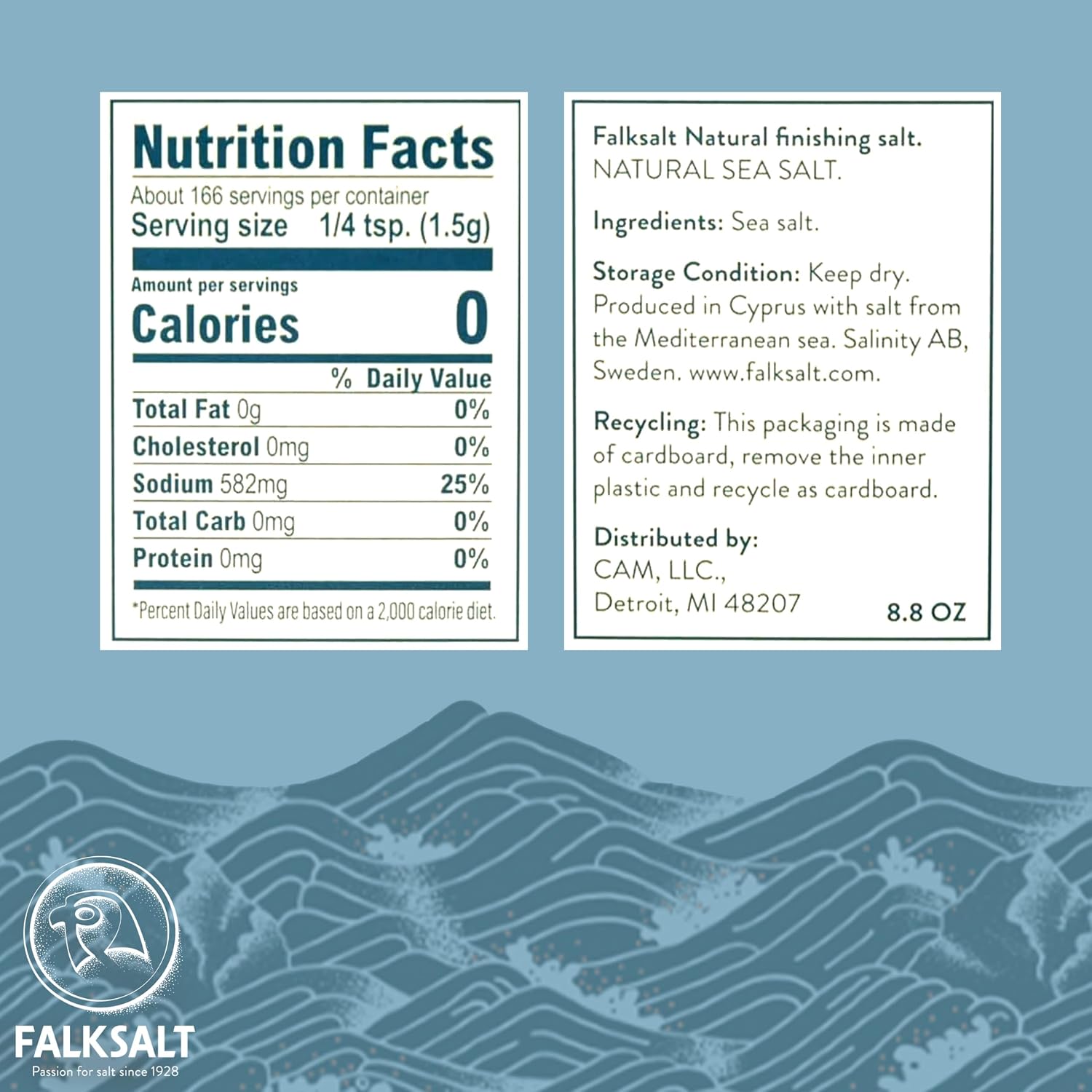
Falksalt, a Swedish brand sold widely across the US market including Williams Sonoma and Amazon, occupies an interesting position: it’s arguably the most accessible of the three alternatives and also the most versatile. The base flake is thin, papery, and almost translucent — lighter even than Maldon in both weight and dissolution speed. Serious Eats’ guide to finishing salts notes that Falksalt’s crystal structure dissolves almost instantaneously on the tongue, which makes it exceptional for applications where you want salt presence without textural crunch — a fine dark chocolate bark, a composed salad where you don’t want crunch competing with the greens, or delicate raw fish.
Falksalt also sells flavored and infused varieties (citrus, herbs, smoke), which makes it a natural gifting product and an easy on-ramp for people who are just starting to explore beyond Maldon. At $10–$18 per 4.4 oz, it’s the most price-competitive of the three alternatives.
The tradeoff: The very lightness that makes Falksalt elegant also limits it. On anything robust — a thick steak, roasted root vegetables, anything pulled from a very hot grill — the flakes can dissolve before they deliver. You lose the textural moment that is much of the point of finishing salt. It’s also less of a provenance story than Saltverk or Vancouver Island Salt if that matters to your audience (for gifting, for tasting menus, for a retailer’s shelf narrative).
If X, then Y: If you’re looking for a Maldon alternative that costs roughly the same, is easier to find, and performs better on delicate applications, Falksalt is the move. If you want a salt with a serious origin story and differentiated mineral character, look at Saltverk or Vancouver Island instead.
How to Build Your Decision Framework
At the intermediate level, the practical question isn’t which salt is best — it’s which salt is right for which slot in your workflow. Here is the decision logic:
If your primary use is everyday finishing across a wide range of dishes: Maldon remains the default for a reason. You’d be upgrading for upgrading’s sake. Put that budget toward one of the specialty options below as a second salt.
If you cook a lot of seafood, cured fish, or raw preparations and care about mineral clarity: Saltverk is the premium pick. Budget for it as a specialty purchase, not a daily driver.
If you focus on red meat, charcuterie, or egg cookery and want assertive salinity: Vancouver Island Sea Salt is the underdog worth knowing. Order direct to ensure freshness and availability.
If you want a Maldon-comparable price point with better performance on delicate applications: Falksalt is the practical choice and an easy recommendation for gifting contexts.
If you’re sourcing for a tasting menu or a charcuterie program where provenance and visual texture are part of the plate narrative: Saltverk and Vancouver Island Salt both carry producer stories that hold up in a menu description. Falksalt, while excellent, has a more commodity-adjacent retail footprint that may not carry the same weight.
One note on pricing trends as of May 2026: specialty finishing salt prices have risen 12–18% over the past 24 months, largely driven by energy costs in pan evaporation and logistics from smaller producers. If you find a sale on Saltverk or Vancouver Island Salt direct from the producer, it’s worth stocking up. Their shelf life in a sealed tin is effectively indefinite, and salt does not go stale.
The Maldon box on your counter is a great starting point. But the range of what’s out there — across different oceans, different harvesting methods, and different crystal architectures — is genuinely worth exploring. Pick one of these and put it next to your Maldon for a month. The side-by-side education is worth more than any guide we can write.