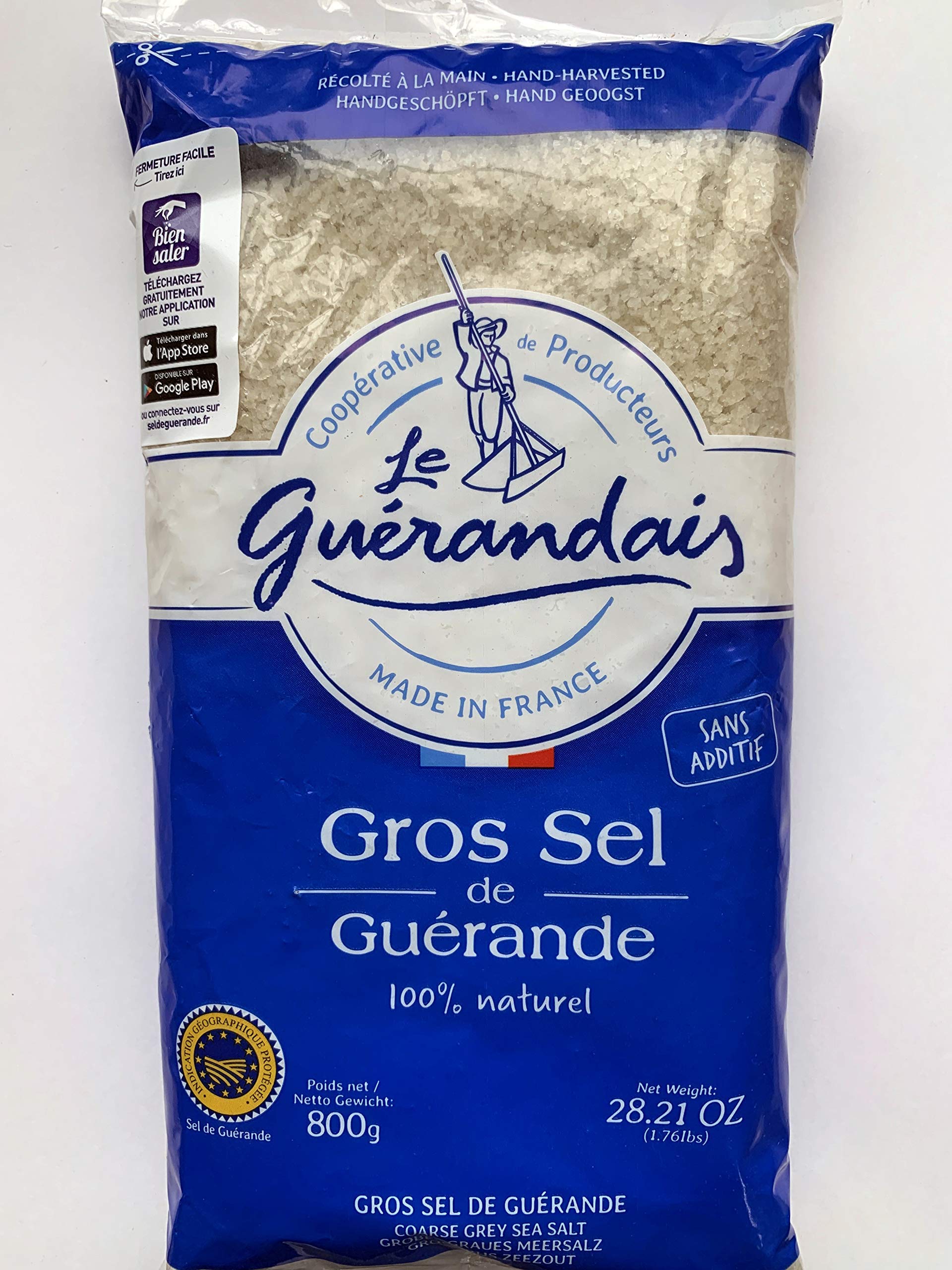
If you’ve been cooking with Morton iodized salt your whole life and recently found yourself standing in front of a shelf of artisan salts wondering what any of it means, this is your guide. And if you already own Maldon flakes and a tin of Fleur de Sel and you’re thinking about what to add next — this is especially your guide. Celtic sea salt (sometimes called sel gris, which is French for “grey salt”) is the category that sits between everyday kosher salt and precious finishing flakes. It’s harvested from tidal clay ponds along the Atlantic coast of France, and it comes out of the harvest naturally moist, irregularly shaped, and tinted a pale grey from the minerals it picks up from the clay. That mineral content — trace magnesium, calcium, potassium — is what gives it a flavor that’s rounder and more complex than standard table salt. It’s not a garnish salt you sprinkle at the table. It’s a working salt, a seasoning salt, the one that does quiet, important work inside the dish. This article will tell you exactly when to reach for it, how it compares to the other salts you probably already own, and which products are genuinely worth the spend.
What Makes Grey Salt Different From Everything Else in Your Pantry
Let’s map the landscape clearly, because the differences here are functional, not just aesthetic.
Table salt (Morton iodized, et al.) is heavily refined, stripped of trace minerals, and very dry. Its crystals are tiny and uniform, which means it dissolves fast and seasons aggressively. You need less of it by weight than almost any other salt, which is why recipes calibrated for table salt can taste under-seasoned when you substitute a flakier, less dense salt.
Kosher salt (Diamond Crystal, Morton Kosher) is still refined but much coarser, with no iodine and no mineral complexity. It’s the chef’s workhorse for a reason — it’s easy to pinch, it dissolves at a controllable pace, and it seasons evenly. But it has almost no flavor beyond “salty.”
Fleur de Sel (the white, delicate hand-skimmed crystals that form on the surface of the same Atlantic ponds) is the sister product to grey salt. It’s the one everyone talks about. Fleur de Sel is prized for its light, crisp texture and subtle flavor — it’s a finishing salt, applied after cooking so its crystal structure survives contact with the plate.
Celtic sea salt / grey salt is what’s left after the Fleur de Sel is skimmed away: the salt that sinks to the bottom of those clay-lined tidal ponds. It’s harvested by hand with a long wooden rake called a las (a traditional tool used by paludiers, the salt farmers of Brittany). The clay contact gives it that distinctive grey color and adds the mineral ions that table salt and most kosher salt lack. It retains 2–13% moisture by weight, depending on the producer and lot — that moisture is not a quality defect; it’s structural. Per Fine Cooking’s salt primer, that residual moisture affects how the salt dissolves on food and how it behaves in different cooking applications.
Serious Eats’ writing on salt science notes that mineral content in sea salts is real but modest — it won’t dramatically change the sodium level of your cooking, but it does affect flavor perception. Tasters consistently describe mineral-forward salts as “rounder,” “less sharp,” and “more complex” than refined salts of equal saltiness. That perception is why grey salt has a loyal following among chefs who season from inside the dish rather than on top of it.
The Practical Tradeoffs: When Grey Salt Wins and When It Doesn’t
Here’s the decision frame you actually need if you’re building a working salt pantry.
Grey salt wins when:
- You’re doing long brines, cures, or dry rubs where mineral complexity has time to integrate into the food. Charcuterie in particular benefits — pork fat is an excellent vehicle for mineral flavor, and a grey salt cure produces a noticeably more nuanced product than a pure kosher salt cure. Food & Wine’s chef-sourced salt feature cites sel gris consistently in charcuterie contexts for exactly this reason.
- You’re roasting root vegetables, potatoes, or whole chickens where the salt goes on before the oven and has time to dissolve into the surface. The moisture in grey salt helps it adhere and begin osmotic seasoning almost immediately.
- You want one salt that does both seasoning and a moderate finishing role. Grey salt’s crystals are substantial enough that a pinch on top of a bowl of soup or a piece of grilled fish delivers a satisfying crunch — not as elegant as Fleur de Sel, but present.
- You’re cooking in volume — for a dinner party, a catering event, a tasting menu — and you want your workhorse salt to have more character than Diamond Crystal without spending Fleur de Sel money on every pot of water.
Grey salt loses when:
- You need precise, dry-weight seasoning control. The moisture content varies between producers and can make recipe scaling less predictable. If a baking recipe calls for kosher salt by weight and you substitute wet grey salt, you may need to compensate.
- You want a visually pristine white finishing crystal. Grey salt on top of a pale dish (burrata, crudo, pale sashimi) looks muddy rather than jewel-like. This is when you want Fleur de Sel or Maldon flakes.
- You’re in a high-speed line-cook environment where speed of dissolution matters for saucing or last-second seasoning. The coarser, moister crystals don’t disappear into a pan sauce as quickly as fine table salt.
By the numbers:
| Salt Type | Avg. Crystal Density | Approx. NaCl % | Typical Moisture | Price Range (100g) |
|---|---|---|---|---|
| Table salt (Morton iodized) | Very high | ~99.9% | <0.1% | <$0.10 |
| Diamond Crystal Kosher | Medium | ~99.5% | <0.1% | ~$0.25 |
| Celtic grey salt (standard) | Medium-low | 84–87% | 2–13% | $0.60–$1.20 |
| Fleur de Sel de Guérande | Low-medium | ~84% | 1–3% | $2.00–$4.00 |
(Crystal density figures based on published culinary research; pricing reflects May 2026 market conditions across major U.S. specialty food retailers.)
Which Products Are Actually Worth Buying
Saveur’s field guide to sea salt draws a useful distinction between authentic sel gris — hand-harvested from Guérande or the Île de Ré in France under traditional methods — and products marketed as “Celtic sea salt” that may be mechanically harvested or sourced from less regulated Atlantic regions. The distinction matters both for flavor and for supporting the paludier tradition that keeps these salt marshes functioning.
For most home cooks and intermediate practitioners: The brand most consistently cited by both culinary educators and specialty food reviewers is Le Paludier de Guérande — a cooperative of traditional salt farmers whose grey salt is harvested by hand, lightly dried, and packaged without additives. It’s widely available through specialty retailers and is the reference product that Fine Cooking and The Kitchn both use in their grey salt explainers. At roughly $8–$14 for a 500g bag, it represents strong value for a mineral-forward salt that can serve as your primary cooking salt.
For charcuterie programs and professional use in volume: Look at La Baleine Coarse Sea Salt (widely distributed, consistent, accessible price point) for everyday seasoning volume, and reserve the Guérande cooperative product for cure blends and finishing applications where provenance is part of the story you’re telling guests or students.
For gifting and retail display: Sel Gris de Guérande in ceramic crocks from producers like Lie Gourmet or through specialty importers like The Meadow hit the $22–$38 range and photograph beautifully. The ceramic crock matters here not just aesthetically — it helps maintain the right moisture level in the salt. The Kitchn’s explainer specifically notes that proper storage is part of the grey salt experience; a sealed plastic bag does the job at home, but a crock elevates both function and presentation.
If you’re already comfortable with Maldon and want to explore: Consider splitting your pantry into three working positions — Diamond Crystal kosher for high-volume cooking, a quality grey salt for brines/cures/roasting, and Maldon or Fleur de Sel for finishing. That three-salt system covers virtually every culinary application without overlap and without spending money on redundancy.
How to Taste the Difference (Without Overthinking It)
The best argument for grey salt is a simple side-by-side tasting that you can set up in five minutes. Pinch a few crystals of grey salt and dissolve them on your tongue. Then do the same with Diamond Crystal kosher. The kosher salt will taste sharp and clean — sodium-forward and nothing else. The grey salt will taste saltier for a moment, then open up into something more complex: a mild earthiness, a slight mineral bitterness at the back of the palate that food writers often describe as “oceanic.” That’s the clay minerals doing their work.
Now try the same comparison on a plain boiled potato. The difference is subtle but real, and it’s the kind of difference that accumulates across a whole meal when you’re using the grey salt as your primary seasoning vehicle.
Food & Wine’s chef interviews on this topic consistently come back to one theme: seasoning with more complex salts means you can use slightly less of them for the same perceived saltiness, because the mineral character provides flavor cues that your palate interprets as “depth” rather than just “sodium hit.” That’s not a reason to use grey salt as a sodium-reduction tool — but it is a reason why professional kitchens are willing to spend more per pound on mineral-forward salts for their seasoning stations.
The Decision Rule
If you cook proteins, vegetables, or cured meats from scratch and you’re currently using only kosher salt as your workhorse, grey salt is the single highest-leverage upgrade you can make to your pantry for under $15. It does everything kosher does, and it adds mineral character that you’ll notice in long applications.
If you already have a finishing salt (Maldon, Fleur de Sel) and you want to complete the system, grey salt fills the middle position — the seasoning salt with enough personality to make your cooking more interesting without demanding that you think about it at the table.
If you’re sourcing for a professional program, a charcuterie curriculum, or a catering kitchen where provenance is part of your story: specify Guérande cooperative product, verify the hand-harvest certification on the packaging, and treat the grey-to-white salt ratio on your board or plate as a deliberate textural and flavor decision rather than an afterthought.
The mineral-forward workhorse your pantry is missing costs less than a decent bottle of olive oil and lasts six months in a sealed container. That’s the math. Add it.