If you’ve ever shaken table salt over a finished steak and wondered why it tastes flat compared to a steakhouse plate, the answer is almost entirely physical, not chemical. Finishing salt — meaning salt added after cooking rather than during — works differently from the fine-grain salt you stir into pasta water. Instead of dissolving invisibly into food, finishing salt sits on the surface, where its crystal shape, size, and density determine how it hits your tongue, how it clings to the crust of a sear, and whether it delivers that little burst of seasoning that makes the last bite as good as the first. This guide breaks down exactly why crystal structure matters for steak specifically, how timing changes the outcome, and which salts are worth adding to your pantry right now — whether you’re reaching for your second specialty salt or your twelfth.
Why Crystal Structure Is the Whole Game on Steak
Here’s the tradeoff nobody tells you when you’re browsing the salt aisle: a finishing salt that performs beautifully on a salad or a chocolate chip cookie may actively disappoint on a hot, fatty cut of beef.
The reason comes down to dissolution rate — how fast the crystal melts when it contacts the warm, moist surface of a rested steak. Per Serious Eats’ food science writing on salt (specifically J. Kenji López-Alt’s deep-dive on salt behavior), fine-grain salts dissolve almost instantly on contact with any moisture. That’s ideal for baking and brining. On a seared ribeye, though, you want some of that crystal to survive long enough to reach your mouth intact, where it delivers a focused hit of salinity rather than a flat background note.
The crystal types you’ll encounter most often in the specialty salt market:
- Flake salt (Maldon being the canonical example): thin, irregular pyramidal or plate-like crystals with a lot of surface area and low density. They dissolve quickly but not instantly, and their wide, flat shape means they adhere to crust without sliding off. The texture — that faint crunch before the salt dissolves — is what people are actually chasing on steak.
- Coarse pyramid crystals (Fleur de Sel, some French grey salts): denser, slower to dissolve, more mineral complexity because they’re harvested from the surface of salt ponds by hand. On steak, they deliver a slightly longer textural moment and carry the briny, oceanic mineral notes that make expensive salt worth the price.
- Coarse chunky crystals (Himalayan pink, many kosher varieties): too slow to dissolve on a finished steak. You’ll crunch through them before they season the meat. These are finishing salts in name only on beef — they’re better suited to a salt block presentation or a cheese board.
Fine Cooking’s salt buying guide makes the point plainly: for any protein finishing application, what you want is a crystal that dissolves in your mouth, not one that grinds between your teeth. That’s your first decision rule.
The Timing Question: When You Add It Matters More Than Most People Think
The second lever — and the one that separates good steak from great steak — is timing. This is where the tradeoffs get concrete.
Add finishing salt right before plating or at the table. Not 30 seconds before, not “while it’s resting.” The logic: once a flake salt contacts the warm, juicy surface of a rested steak, moisture begins pulling it down into the meat. Within 60–90 seconds on a hot surface, a significant portion of your Maldon flakes have dissolved and the textural payoff is gone. What remains tastes saltier (more surface area = faster ion release) but loses the crunch that justifies using an $8–$12 box of Maldon instead of Morton.
Saveur’s editorial guide on sea salt notes that professional kitchens typically add finishing salt at the pass — the last surface the plate touches before service — for exactly this reason. At home, that translates to: salt the plate or the surface of the steak after it’s been sliced and arranged, in the last five seconds before it hits the table.
One exception worth knowing: if you’re serving a thick-cut bone-in ribeye or a tomahawk where the sear crust is dense and dry, you have slightly more time. The crust acts as a moisture barrier, slowing the dissolution of even large flake crystals. Reviewers of higher-end salts on platforms like Williams Sonoma consistently note this — chefs working with thick cuts have a wider window before the textural benefit degrades.
By the Numbers: Quick Crystal Reference
| Salt type | Avg. crystal density | Dissolution speed on warm steak | Best for |
|---|---|---|---|
| Maldon Sea Salt Flakes | Low (hollow pyramids) | 30–60 sec | Everyday finishing, any cut |
| Fleur de Sel de Guérande | Medium (irregular grains) | 60–90 sec | Delicate or thin-cut beef |
| Jacobsen Pure Flake | Low–medium | 45–75 sec | Leaner cuts, Pacific brine flavor |
| Saltverk Birch Smoked Flaky | Low (flake structure) | 30–60 sec | Grilled beef, crust-forward applications |
| Hana Flake Hawaiian Sea Salt | Very low (ultra-thin) | 20–45 sec | Finishing at the table only |
Crystal density and dissolution ranges sourced from published culinary research cited in Fine Cooking and Serious Eats editorial coverage; Hana Flake behavior per Tasting Table’s finishing salt feature.
Our Current Quarterly Picks (May 2026 Update)
This section is updated quarterly based on new releases, pricing shifts, and patterns in chef and home-cook reviews across aggregated sources. Here’s where things stand heading into summer 2026.
Best Everyday Workhorse: Maldon Sea Salt Flakes ($8–$12)
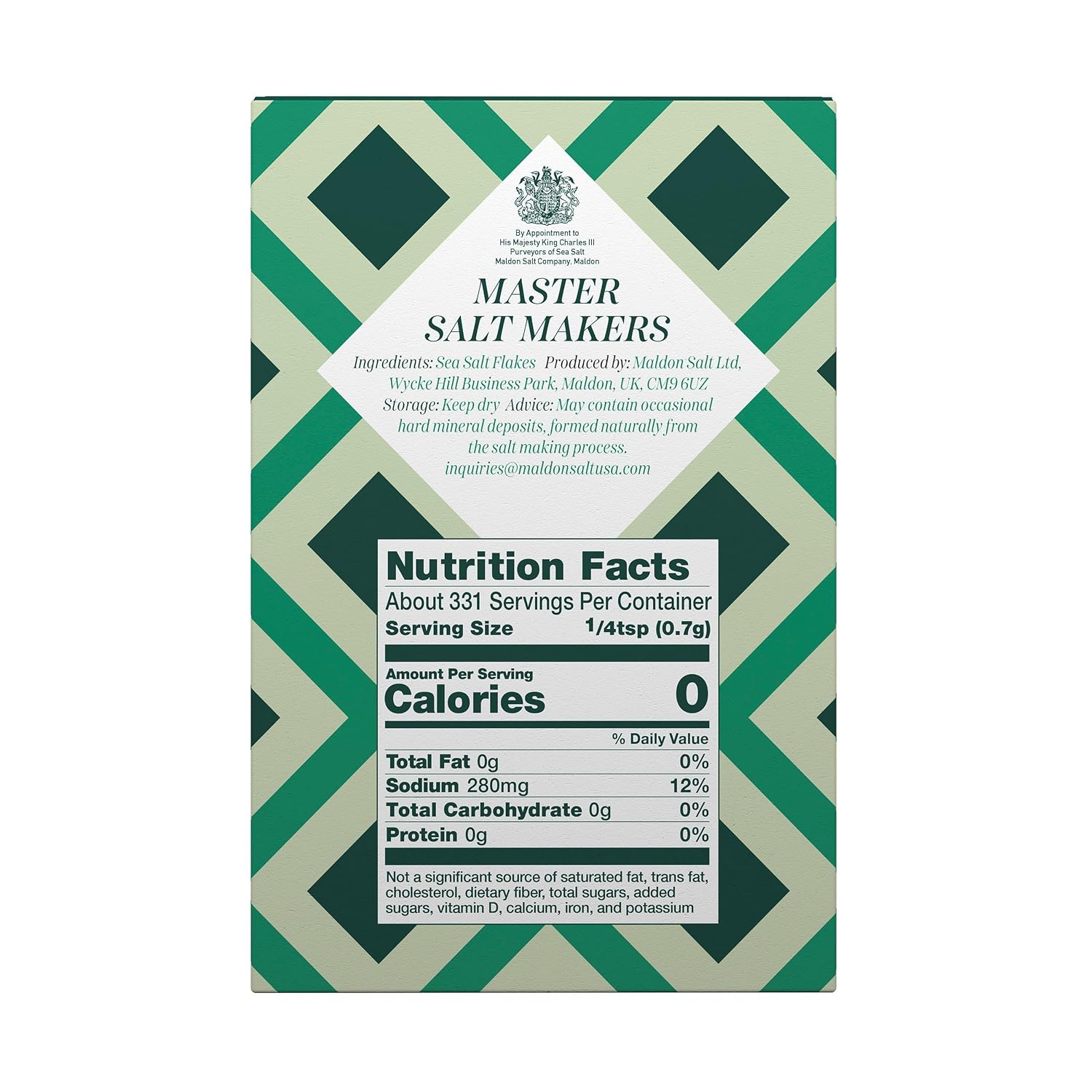
Maldon is the salt that most home cooks reach for when they want to stop using iodized table salt and actually taste something. The pyramid crystals — formed by a slow evaporation process in Essex, England — have a hollow, papery structure that delivers crunch without the harsh sodium spike you get from denser crystals. On steak, the light, irregular flakes cling well to fat and crust.
The value proposition is straightforward: you get a genuinely different textural and flavor experience at a price point where you can use it freely without rationing. Across aggregated reviews at both Williams Sonoma and The Meadow, owners consistently report that Maldon raises their everyday cooking noticeably without requiring them to think too hard about application. This is the right answer if you’re building your first specialty salt pantry and want one salt that earns its spot on the counter.
Best for a Special Cut: Fleur de Sel de Guérande ($18–$28)
Fleur de Sel — literally “flower of salt” — is harvested by hand from the surface of tidal salt ponds in the Guérande region of France’s Loire-Atlantique coast. The harvest is weather-dependent, seasonal, and genuinely limited, which is why it costs what it costs. The crystals form only when conditions are exactly right: low wind, strong sun, still water. What you get is a moist, irregular grain with a faint mineral complexity that reads as oceanic rather than sharp.
On a thin-cut beef — skirt steak, hanger steak, a sliced bavette — this is our top recommendation. The slower dissolution relative to Maldon gives you a longer textural moment, and the mineral notes complement lean, iron-forward beef better than any purely “salty” salt can. Bon Appétit’s chef-sourced finishing salt guide names Guérande fleur de sel as the default recommendation for beef applications where provenance and mineral complexity are the goal.
The tradeoff: at $18–$28, you’ll find yourself rationing it. That’s not wrong — this is a finishing salt in the truest sense, not a cooking salt. Use it for the one cut you’re proud of, not the Tuesday-night ground beef.
Best Smoked Option: Saltverk Birch Smoked Flaky Salt ($28–$45)
Saltverk is an Icelandic producer using geothermal energy to evaporate seawater harvested from the Reykjanes peninsula — an unusually clean, cold-water source with a distinctive mineral profile. The birch-smoked version cold-smokes the finished flake crystals over Icelandic birch wood, which delivers a subtler, cleaner smoke than many hickory or applewood smoked salts that read as aggressive on beef.
For grilled steak specifically — where you’ve already developed char and smoke from the cooking process — this is the finishing salt that adds a complementary aromatic layer without fighting the plate. Owners across specialty retailer reviews (notably at The Meadow and direct from Saltverk’s site) consistently note that the smoke is present but not overwhelming, and that the flake structure remains intact for finishing use rather than collapsing into a powder the way some smoked salts do.
The decision frame: if your cut is grilled and you want to lean into smoke flavor as a narrative element, this is the buy. If your steak is pan-seared indoors and the smoke would feel incongruous, reach for Maldon or Guérande instead.
Best for the Collector Tier: Hana Flake Hawaiian Sea Salt ($60–$120+ per tin)
Hana Flake is harvested in small batches from the waters off Maui, hand-harvested using traditional methods, and available in limited seasonal runs. The crystals are among the thinnest and most delicate in the specialty salt market — almost translucent, with a clean Pacific salinity and minimal mineral bitterness. Because of the ultra-thin structure, they dissolve on contact more quickly than any other salt in this guide, which means your timing window is tight: table-side only, last second, or lose the texture entirely.
What justifies the price at this tier is provenance, rarity, and the visual story on the plate. Tasting Table’s finishing salt feature describes Hana Flake as “the salt you bring out when the meal is the event.” That framing is accurate. If you’re serving a dry-aged prime ribeye for a special occasion, or building a charcuterie and steak program for a private-dining event where the sourcing story is part of the pitch, this is the salt that earns the conversation.
If you’re a home cook who’s been in specialty salts for under six months, this is probably not your next purchase. If you’ve already worked through Maldon and have a couple of specialty salts in rotation, it’s worth the limited-run splurge at least once.
The Decision Rule
If you want one simple framework to end with:
- Everyday finishing on any steak, any cut: Maldon. It earns the price every single use.
- A cut you’re proud of, mineral complexity matters: Fleur de Sel de Guérande.
- Grilled beef, smoke as a flavor component: Saltverk Birch Smoked Flaky.
- Special occasion, provenance is part of the plate: Hana Flake — table-side, last second, no exceptions.
The one tradeoff worth naming explicitly: the more delicate the crystal, the tighter your timing window. Hana Flake and Maldon are unforgiving if you add them while the steak is still on a hot surface. Guérande gives you more margin. If you know your plating will be rushed or your guests take ten minutes to sit down, a denser, slower-dissolving option protects your investment.
Prices current as of May 2026 across Amazon, Williams Sonoma, The Meadow, and direct producer sites. We update this guide quarterly — if a new harvest or limited release shifts our picks before August, we’ll note it in the revision log.